The nose occupies a central position on the face and has a significant impact on facial harmony. Even small changes to its shape can alter the perception of facial balance and boost personal confidence. For this reason, more and more people are looking for alternatives to improve their appearance while maintaining a natural look.
There are currently several options for nasal enhancement. Some people desire a permanent transformation through surgery, while others prefer less invasive procedures that offer quick results with minimal recovery time. Understanding the differences between these two alternatives is essential for making an informed decision.
The non-surgical rhinoplasty has gained popularity thanks to advances in aesthetic medicine, offering a solution to correct minor imperfections using injectable substances. However, this procedure does not replace rhinoplasty, as both techniques have completely different goals, scopes, and limitations.
Dr. César López Romero believes that the best option will always be the one that addresses the anatomical needs and expectations of each patient. With a personalized assessment, it is possible to determine which procedure will achieve safe, natural results that are in harmony with the facial structure.
What is a non-surgical rhinoplasty?
A non-surgical rhinoplasty is a minimally invasive aesthetic procedure that improves the contour of the nose through the application of dermal fillers, typically made of hyaluronic acid.
Its goal is to correct minor irregularities in the nasal profile, slightly lift the tip, improve symmetry, or camouflage depressions without the need for incisions or modifying the bone or cartilage structure.
The treatment is usually performed in the office under topical or local anesthesia and typically lasts between twenty and forty minutes. Results are visible almost immediately, which explains its growing popularity among those seeking quick changes.
However, it is important to understand that this is a temporary procedure and can only correct minor defects related to the external shape of the nose.
What is a rhinoplasty?
Rhinoplasty is a surgical procedure designed to permanently modify the structure of the nose.
During surgery, the specialist can reshape bone, cartilage, and soft tissue to improve both aesthetic appearance and respiratory function when anatomical issues are present.
Unlike non-surgical nose job, rhinoplasty allows for reducing the size of the nose, narrowing the nasal bridge, correcting significant deviations, modifying the tip, and resolving functional issues such as breathing difficulties caused by a deviated septum.
Due to its ability to make structural changes, it remains the gold standard procedure for those seeking a permanent transformation.
What is the main difference between the two procedures?
The most important difference lies in the type of change that can be achieved.
The non-surgical nose job adds volume at strategic points to visually improve the nasal profile, while rhinoplasty modifies the anatomy of the nose by removing, reshaping, or repositioning tissues.
This means that a non-surgical nose job improves appearance through optical illusion, while surgery physically transforms the nasal structure.
For this reason, the two procedures do not compete with each other, but rather address completely different needs.
Goals of a non-surgical nose job
Improve minor irregularities
This procedure is ideal for smoothing out depressions, correcting slight asymmetries or camouflaging a small bump through visual profile redistribution.
Lift the nasal tip
In some patients, it is possible to achieve a subtle lift of the tip using small, carefully placed amounts of hyaluronic acid.
Improve facial harmony
By correcting minor imperfections, the nose can integrate more balancedly with the rest of the features without radically altering the face's expression.
Achieve immediate results
One of the main advantages of the procedure is that the changes are visible almost immediately after application.
Rhinoplasty goals
Reduce nose size
Surgery can reduce nasal volume when the nose is too prominent in relation to the rest of the face.
Modify the nasal bridge
It can remove a pronounced hump or completely reshape the nasal bridge for a more harmonious profile.
Correct functional issues
Many rhinoplasties also aim to improve breathing through correction of the nasal septum or other internal structures.
Create permanent results
Once recovery is complete, the changes achieved through rhinoplasty are long-lasting and do not require periodic touch-ups.
How is non-surgical rhinoplasty performed?
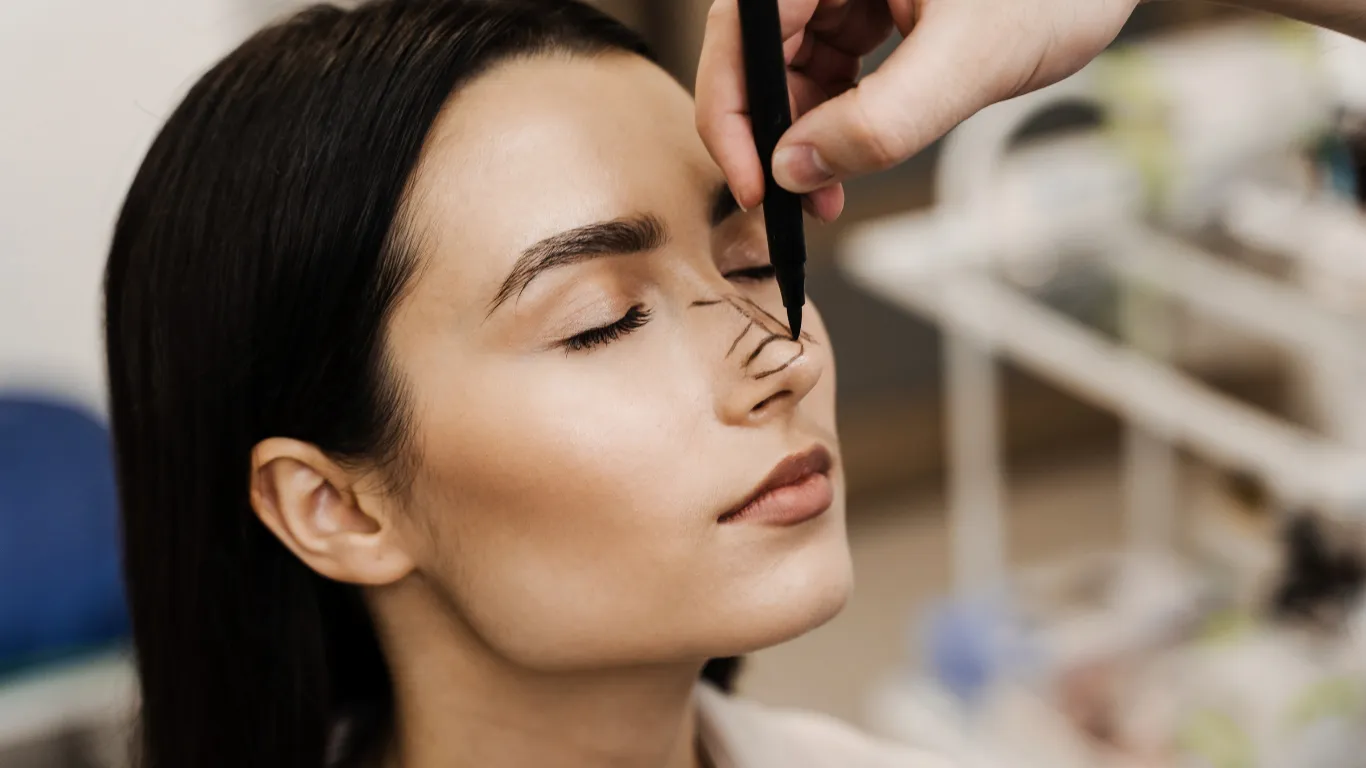
After assessing facial anatomy, the specialist identifies the areas that can benefit from the treatment.
Hyaluronic acid is then applied using fine needles or special cannulas at strategic points on the nasal bridge and tip.
The procedure requires great precision, as the nose has a complex blood supply and any incorrect application can lead to significant complications.
For this reason, it should only be performed by doctors with extensive experience in facial anatomy.
How is a rhinoplasty performed?
Rhinoplasty is performed in an operating room under local anesthesia with sedation or general anesthesia, depending on the case.
The surgeon makes carefully planned incisions to access the internal structures and reshape bones, cartilage, and soft tissues.
Depending on the patient's needs, the surgery can be open or closed.
Once the modifications are complete, splints and bandages are applied to help protect the new nasal structure during the first few weeks.
Recovery time
One of the differences that most influences a patient's decision is the recovery period.
The non-surgical rhinoplasty allows for an almost immediate return to daily activities. Slight swelling, redness, or minor bruising may occur, but these disappear within a few days.
In contrast, rhinoplasty requires a longer recovery process.
During the first week, it is common to wear a nasal splint and experience swelling or bruising around the eyes.
Although many activities can be resumed after one or two weeks, the final result is usually visible between six months and a year later, as the swelling completely subsides.
Duration of results
Duration is another fundamental difference.
The results of non-surgical rhinoplasty are temporary.
Depending on the patient's metabolism, the type of hyaluronic acid used, and individual characteristics, the effects typically last between nine and eighteen months.
Rhinoplasty offers permanent changes, although the natural aging process will continue to gradually alter the tissues over the years.
Who is a candidate for non-surgical rhinoplasty?
This procedure is suitable for patients with minor aesthetic irregularities who want subtle improvements without undergoing surgery.
It is also an excellent option for those who want to visualize how certain changes would look before considering a permanent rhinoplasty.
However, it is not recommended when there is a very large nose, significant deviation, breathing issues, or expectations that can only be met through surgery.
Who is a candidate for rhinoplasty?
Rhinoplasty is indicated for patients seeking permanent structural changes.
It is especially useful for congenital deformities, trauma-related issues, functional impairments, significant septal deviations, or a nose size that is disproportionate to the face.
It is also the indicated treatment when the goal is to reduce the volume of the nose, which cannot be achieved with fillers.
Advantages of non-surgical rhinoplasty
One of its main advantages is that it does not require hospitalization or general anesthesia.
The procedure is quick, minimally invasive, and offers virtually immediate results.
Furthermore, patients can quickly return to their daily activities.
Another significant advantage is that the hyaluronic acid can be dissolved using specific enzymes if adjustments are needed.
Advantages of rhinoplasty
Rhinoplasty allows for the resolution of issues that no injectable procedure can correct.
In addition to improving aesthetic appearance, it offers functional benefits by optimizing breathing when there is an anatomical impairment.
Its results are permanent and allow for fully customized modifications based on each patient's facial features.
Risks and important considerations
Both procedures must be performed exclusively by experienced specialists.
Although non-surgical rhinoplasty may seem simple, the nose contains delicate blood vessels that, if obstructed, can lead to severe complications.
Rhinoplasty, on the other hand, carries the risks inherent to any surgical procedure, including swelling, bleeding, infection, and the occasional need for revision procedures.
A proper medical assessment significantly reduces these risks and allows for the selection of the safest alternative.
Which one offers more natural results?
Natural-looking results depend far more on the specialist's experience than on the procedure chosen.
When both treatments are properly planned, it is possible to achieve a harmonious nose that preserves the patient's facial identity.
The current goal of plastic surgery is not to completely transform the face, but to enhance its balance while respecting individual features.
How do you choose between non-surgical rhinoplasty and rhinoplasty?
The decision should be based on your personal goals.
If the patient only wishes to correct minor irregularities and is looking for a temporary solution with immediate recovery, non-surgical rhinoplasty can be an excellent alternative.
However, when there are structural issues, breathing problems, or a desire for a permanent change, rhinoplasty remains the best option.
A professional assessment allows us to analyze the nasal anatomy, understand the patient's expectations, and recommend the most appropriate treatment.
Frequently Asked Questions
Can non-surgical rhinoplasty reduce the size of the nose?
No. This procedure only adds volume to specific areas to improve the profile. It does not remove tissue or reduce nasal size.
Does rhinoplasty correct breathing problems?
Yes. When breathing issues are related to a deviated septum or other internal structures, surgery can significantly improve nasal function.
Are the results of non-surgical rhinoplasty permanent?
No. Hyaluronic acid is gradually reabsorbed, so the treatment requires maintenance sessions to preserve the results.
Which procedure has a faster recovery?
Non-surgical rhinoplasty allows you to return to your daily activities almost immediately, while rhinoplasty requires several weeks of recovery and a few months to see the final result.
How do I know which procedure I need?
The best way to decide is to schedule an assessment with a board-certified plastic surgeon. The specialist will evaluate your nasal anatomy, listen to your goals, and determine which alternative offers the best results for your case.
Discover the best option for your features
Non-surgical rhinoplasty or rhinoplasty requires much more than just comparing recovery times or the duration of results. Each procedure addresses different needs, and only a personalized assessment can determine which one will provide a safe, harmonious result that aligns with your expectations.
Dr. César López Romero combines experience, anatomical knowledge, and an individualized approach to recommend the most suitable treatment for each patient. If you want to improve the appearance of your nose and find out which alternative best suits your goals, book a consultation and receive a professional evaluation that will allow you to make a decision with confidence.